-
What is the Linear Model?
The Linear Model views communication as a process where a message is sent from a sender to a receiver in a straight line. In this model, the receiver is passive; they listen or watch but do not provide immediate feedback.
Key Characteristics:
-
One-Way: Information flows in only one direction.
-
No Feedback: There is no concept of a “reply” or “response” within the model itself.
-
Focus: It prioritizes how the message is transmitted and the effects it has on the receiver.
2. The Core Elements
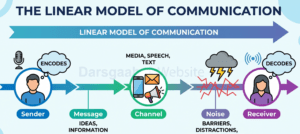
Linear Model Of Communication To remember this for the exam, visualize this sequence:
-
Sender (Encoder): The person who starts the message.
-
Message: The information or content being shared.
-
Channel: The medium used (radio, book, television, speech).
-
Receiver (Decoder): The person who gets the message.
-
Noise: Any interference (physical, psychological, or semantic) that distorts the message.
3. Key Linear Models (Short Summary)
-
Aristotle’s Model: The oldest model. It is all about Public Speaking. The speaker crafts a speech for a specific audience to achieve a certain effect.
-
Lasswell’s Model (1948): Often used in Mass Media. It asks five simple questions:
-
Who? (Sender)
-
Says what? (Message)
-
In which channel? (Medium)
-
To whom? (Receiver)
-
With what effect? (Impact).
-
-
Shannon-Weaver Model: The most famous one. It introduced Noise (disturbances). It was originally designed for radio and telephone communication, explaining how a signal travels from a transmitter to a receiver.
-
Berlo’s SMCR Model: Breaks communication down into four parts: Source, Message, Channel, and Receiver. It highlights that the communication is only successful if the Sender and Receiver have similar skills, attitudes, and knowledge.
-